1. Home
  2. Industries
  3. Home services
  4. Roofing companies

Roofing sales dialer

How roofing companies run storm and inspection inquiry follow-up on DialBreeze: three lines per rep, a recording of every connected call, and an AI summary that captures the roof age, the damage event and the inspection window the homeowner agreed to.

Updated September 28, 2026Home services

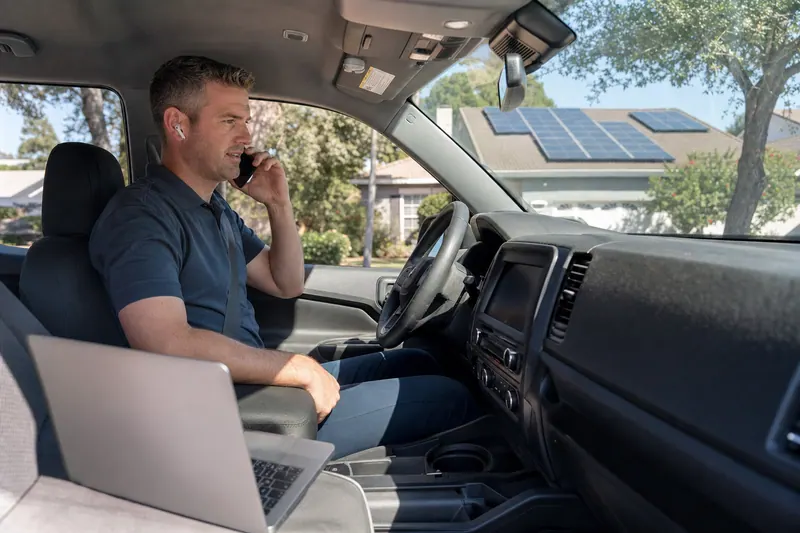
A home services rep on a call from his truck, solar panels on the roof behind

The short answer

DialBreeze is a browser power dialer for roofing reps following up on inspection requests, storm-event inquiries and estimate approvals. It rings up to three numbers at once, records every connected call, and after the call writes a summary with the roof age, the damage event, the insurance situation and the booked inspection window. The rep does all the talking. Calling runs on your own Telnyx account.

A calling day for roofing companies.

The moments where a dialer, a recording and an after-call note change the outcome. Illustrative, not a customer story.

  1. 7:45 AM · the rep opens a list of 60 homeowners who requested inspections after last week's hail event, newest first, with the neighborhood and event date on each row.

  2. 8:05 AM · three lines ring. One voicemail gets the recorded drop, one is a rental property (wrong roof, note taken), the third answers: a homeowner whose neighbor had tarps on the roof. The rep asks about the roof age, the last inspection and whether insurance has been contacted.

  3. 8:15 AM · disposition 'Inspection booked', today between 4 and 6. The AI summary is on the lead: 18-year-old 3-tab shingle, hail event June 9, no insurance claim yet, spouse works evenings so the 4-to-6 window matters.

  4. 11:00 AM · estimate-approval block. Homeowners with signed-inspection reports get called about approve-and-schedule decisions, summaries attached.

  5. 3:00 PM · the manager reviews the week's calls where homeowners asked 'will my premium go up', and aligns the team's answer to what the state's rules actually allow.

The workflow, list to follow-up.

The same four moves every session, described the way roofing companies work.

  1. Import the inquiry list as a CSV with source, event date and neighborhood notes. Your internal DNC list, quiet hours and attempt caps apply before the session.
  2. Dial up to three lines. Take the live answer; drop your recorded voicemail on the rest.
  3. Disposition in roofing terms: Inspection booked, Estimate follow-up, Insurance claim started, Deductible conversation, Not interested, Wrong roof, Do not call.
  4. The AI note captures roof age, event date, insurance status and household timing, so the inspection and the estimate land on the homeowner's actual calendar.

What the notes look like after a call.

After each recorded call, DialBreeze writes a transcript, pulls out the fields this job cares about and suggests a next step. The card is a sample with fictional data. Check important details against the recording.

Dispositions for this workflow

  • 1Inspection booked
  • 2Estimate follow-up
  • 3Insurance claim started
  • 4Deductible conversation
  • 5Not interested
  • 6Wrong roof
  • 7Unreachable
  • 8Do not call
AI summarySample
Intent
Post-hail inspection request
Roof
18-year-old 3-tab shingle; two prior patch repairs
Event
Hail, June 9; neighborhood confirmed
Insurance
Claim not filed; homeowner unsure of deductible
Household
Spouse home after 4 PM; wants inspection before leaving for vacation June 24
Objection
Worried a claim will raise the premium
Next stepInspection today 4:00-6:00 PM; bring deductible explainer; do not promise claim outcomes

Storm windows are won by speed and honesty

After a hail event, every roofer in the county is calling the same neighborhoods. The company that calls first, asks real questions and books an inspection window that fits the household’s calendar gets the roof. The company that opens with “free roof” talk gets the complaint. The dialer’s contribution is mechanical and decisive: three lines ringing through the inquiry list, summaries that carry the roof facts forward, and a booked window with a time attached.

Storm work also has a memory problem: inquiries spike, canvass sheets pile up, and two weeks later half the list was never called. A queue with fresh-first ordering and a recording on every connected call closes that gap.

The four facts that book the inspection

Roof age and type, the event they noticed, insurance status, and when the household is actually available. The last one decides more inspections than the first three. “Spouse home after 4 PM, leaving for vacation on the 24th” is the difference between a booked window and a missed one, and the AI summary holds it in the homeowner’s own words.

The insurance question needs the most discipline. A homeowner unsure of their deductible needs a factual explainer, not a prediction about their premium or a promise about approval. The recording keeps every rep inside that line, which is exactly the reputation storm markets reward.

Wrong roofs and rental properties

A meaningful share of any storm list is rentals, shaded wrong-addresses and roofs replaced last year. “Wrong roof” is a real disposition with a reason attached; it saves the measurement and inspection hours and keeps the pipeline honest. The summary notes what it actually was, because in two years that rental changes owners and the list lives on.

Estimate approvals are the quiet list

Homeowners with inspection reports in hand are a different conversation: approve, schedule, and the deductible or financing question. Those calls are logged with their own dispositions and summaries, and they are where revenue actually materializes. The team that works estimate follow-up as deliberately as storm inquiries converts the same storm into more roofs.

The rules that matter in roofing

Telemarketing basics, consent evidence, all-party recording consent in several states, the FTC Impersonation Rule (nobody from your company is an adjuster), state licensing and the deductible-inducement rules several states impose. The complaints that stick are the misrepresentations; the recording plus a disciplined script is your best protection. DialBreeze enforces the mechanics you configure; claims and licensing are yours. Nothing here is legal advice.

The insurance-status conversation, handled straight

Nothing in storm roofing generates more trouble than the insurance conversation, and the recording is where the discipline lives. The homeowner asks the two questions every time: will my premium go up, and will you handle the claim. The honest answers are the ones your state’s rules and your role allow: you are not the adjuster, claim outcomes are the carrier’s call, and the inspection documents damage rather than guarantees a check. Every rep saying that the same way, on tape, is worth more than any marketing.

The Impersonation Rule draws the hardest line: nobody from a roofing company poses as an adjuster or implies carrier affiliation, and “we work with your insurance” phrasing belongs in the trash. The manager who audits the week’s calls for that phrasing finds it in minutes, because the recordings are searchable and the summaries carry the conversation’s shape.

Crew planning runs on the summaries

A storm week creates a logistics problem as much as a sales one: which neighborhoods first, which roofs need the ladder crew, which inspections can share a street. The summaries carry the neighborhood and roof facts from every call, so the office plans routes from real data instead of the canvass sheet’s guesswork. The rental and wrong-roof dispositions keep the crew list clean, and the estimate-approval block feeds the install calendar directly.

After the season, the same record becomes the production review: calls to bookings, bookings to installs, and the conversations that produced each. Teams that keep this habit enter the next storm already knowing their best opening line.

After the storm, the record is the reputation

Storm markets attract bad actors, and the honest companies differentiate with paperwork: documented inspections, written estimates, recorded promises. The DialBreeze record (the call that booked the inspection, the summary with the roof facts, the estimate follow-up) gives the office a file on every homeowner from first contact to final invoice. When the neighborhood’s Facebook thread asks who to trust, the companies with consistent records and consistent answers on tape are the ones customers defend.

The same record disciplines the surge staffing. Storm weeks are staffed with temp reps, and the recording plus the disposition set keeps their quality at the permanent team’s level: the manager reviews a temp’s first day from the tape instead of riding along, and the summaries keep the insurance-status facts accurate no matter who collected them.

Off-season calling is where next season’s margin lives

Between events, the roofing pipeline thins and the temptation is to stop calling. The off-season block works the warm list instead: inspection reports never converted, estimates from the fall, homeowners who said “after the holidays.” The summaries carry each one’s reason, so the January call opens with their November objection. Contractors who run this block enter the next storm with a booked pipeline and a crew calendar that absorbs the surge instead of drowning in it.

The maintenance-adjacent call belongs here too: the 15-year-old roof flagged during last year’s inspection is a spring conversation with the notes attached. Roofing’s best margins come from the jobs nobody else thought to call about.

What you need to start

  • Your own Telnyx account with numbers and caller ID.
  • Inquiry lists as CSVs with source, event date and neighborhood notes.
  • A recording disclosure and one headset per rep.
  • A disposition set separating storm, estimate and insurance-status work.

The 14-day trial runs in a sandbox. Load a sample inquiry list, run a three-line block, and read the summaries before real homeowners are dialed.

Calling rules to check first.

  • TCPA
  • Telemarketing Sales Rule
  • National DNC and internal DNC
  • Recording consent
  • FTC Impersonation Rule
  • State roofing and insurance-contractor laws

Calls to homeowners who requested inspections are consumer telemarketing under the FTC Telemarketing Sales Rule (16 CFR 310.4): truthful disclosures, 8 AM to 9 PM local time, DNC rules unless consent or an established business relationship applies, and immediate opt-out honoring. The FCC's consent definition is in 47 CFR 64.1200(f); the 2024 one-to-one consent rule was vacated in January 2025 and is not current law. Roofing has specific exposure: the FTC's Impersonation Rule (16 CFR 461.3) bars falsely posing as an insurance adjuster or implying carrier affiliation, several states restrict deductible waivers or rebates as inducements and require contractor licensing, and damage claims must match what an inspection actually finds. Record only what you can verify. Several states require all-party recording consent; use a disclosure. DialBreeze enforces your internal DNC list, quiet hours and attempt caps; claims accuracy and licensing are yours.

This is operational guidance, not legal advice. DialBreeze enforces the internal DNC list, quiet hours and attempt caps you configure; consent and list eligibility stay with yus. How the responsibility splits.

DialBreeze is not a fit if…

Better to know now than in week two of a trial.

  • You want AI voice agents handling storm-response calls. Homeowners after a storm need a human who can hear the urgency.
  • You need estimating, aerial measurement or CRM tools inside the dialer. DialBreeze is the calling workflow next to those.
  • You rely on predictive dialing across a large storm team. DialBreeze is up to three lines per rep.
  • You expect the dialer to police your canvassing or lead practices. The dialer records the calls; list practices are yours.

Questions from roofing companies.

Something missing? Email brayden@themilnerteamfl.com.

What should a storm follow-up call establish?
Roof age, the event they noticed, whether insurance is involved, and when someone is actually home. That is enough to book an inspection window that sticks. Never promise a claim outcome or a free roof on the phone.
What does the AI capture?
Transcript plus structured fields: roof age and type, event date, insurance status, household timing, the objection and the next step. The inspection arrives prepared and the estimate follows the actual findings.
Can we call door-knock canvass contacts?
The phone list and the canvass sheet are different compliance worlds. If the homeowner signed up for an inspection, that consent is your evidence; keep it with the record. Run your canvass-to-call policy past counsel.
Are recordings useful in insurance disputes?
They are useful and sensitive at once. The tape shows what your rep promised, which is exactly why reps should promise nothing about claim outcomes. All-party consent states require a disclosure.
How do deductible conversations work?
Carefully. Several states restrict deductible waivers or inducements; the honest answer is set by your state's rules, not by the competition's pitch. Check with counsel and keep the team's script aligned.
What does it cost per rep?
Solo is $49 a month per seat, or Team is $149 a month for three seats. Your Telnyx account bills calling and numbers separately. AI is included on every plan.

See it on your own call list.

Start a 14-day sandbox trial. We set it up, you run a real session with test numbers, then decide.

Start a 14-day trialPricing