1. Home
  2. Industries
  3. B2B sales & tech
  4. B2B market-research interviewers

Telephone survey dialer B2B

How B2B research firms use DialBreeze for consented telephone interviews: three lines per interviewer, a recording of every completed interview, and an AI summary that captures consent, topics covered and the incentive step.

Updated September 28, 2026B2B sales & techConditional fit: read the calling rules below

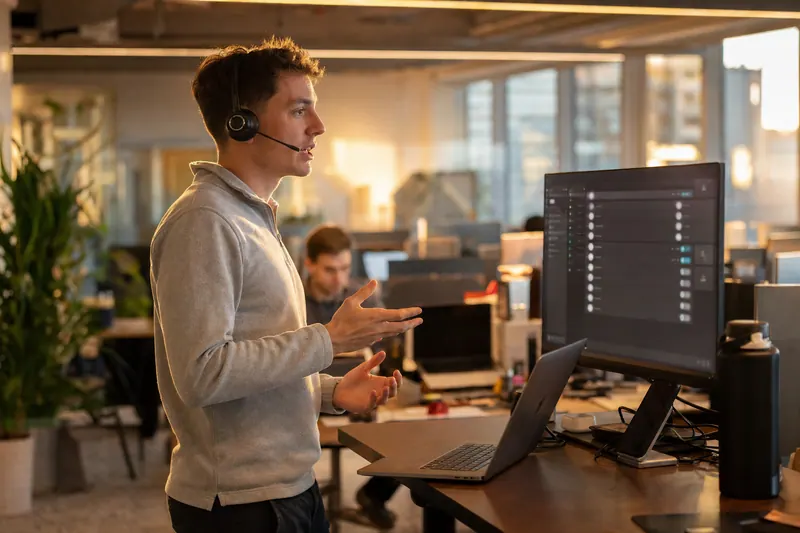
An SDR standing at his desk mid-call, gesturing as he talks

The short answer

DialBreeze is a browser power dialer for B2B research teams running telephone interviews with business respondents. It rings up to three numbers at once, records each completed interview, and after the call writes a summary with the consent given, the topics covered and the scheduling or incentive step. A person on your team conducts every interview. Calling runs on your own Telnyx account.

A calling day for B2B market-research interviewers.

The moments where a dialer, a recording and an after-call note change the outcome. Illustrative, not a customer story.

  1. 8:30 AM · the project lead opens the sample list for a study on software purchasing, containing only companies the client supplied and the field team screened for consent language.

  2. 9:00 AM · three lines ring. One gatekeeper asks for the purpose and the length. One respondent answers and completes a 12 minute interview. One number is disconnected.

  3. 9:40 AM · notes captured: the respondent's role, the topics discussed, the consent statement read and whether the interview was recorded with permission.

  4. 1:00 PM · callback queue. Respondents who asked for a later time are called inside the window they named.

  5. 4:00 PM · the project lead reviews completion rates by segment and confirms every refused or opted-out contact is suppressed before the next wave.

The workflow, list to follow-up.

The same four moves every session, described the way B2B market-research interviewers work.

  1. Confirm the study design first: consent language, recording permission, incentive handling, sample provenance, and the retention policy for interview records.
  2. Load the sample as a CSV with company, contact, role and the consent status attached to each record. Apply the project suppression list before the block.
  3. Dial up to three lines with a live interviewer on every answered call, stating the firm, the purpose and the expected length before any question.
  4. Disposition: Interview complete, Callback requested, Refused, Gatekeeper, Not the right person, Wrong number, Do not contact, Interview partial.
  5. Store the interview record inside the project's retention rules and suppress every refusal and do-not-contact request permanently.

What the notes look like after a call.

After each recorded call, DialBreeze writes a transcript, pulls out the fields this job cares about and suggests a next step. The card is a sample with fictional data. Check important details against the recording.

Dispositions for this workflow

  • 1Interview complete
  • 2Interview partial
  • 3Callback requested
  • 4Refused
  • 5Gatekeeper
  • 6Not the right person
  • 7Wrong number
  • 8Do not contact
AI summarySample
Intent
Completed interview with a qualified respondent
Respondent
IT director at a mid-market manufacturer
Consent
Purpose and length stated; recorded with verbal permission
Topics
Procurement process, current vendor, evaluation criteria, budget cycle
Incentive
Asked whether the honorarium is paid by check or gift card
Scheduling
Declined a follow-up interview
Next stepSend the honorarium with the documentation the respondent requested, log the verbatim answers to the questionnaire, and record the refusal of a follow-up so the next wave does not re-contact

A B2B research project lives or dies on completed interviews, and completing them means getting a busy professional to spend ten minutes on the phone. The dialing is unglamorous: gatekeepers, wrong numbers, disconnects, and a small number of people who are willing to talk.

What separates research interviewing from sales calling is the record. Every interview needs to show that the purpose and length were stated, that the respondent agreed, and that any recording was permitted. That record is the product as much as the answers are.

DialBreeze rings up to three numbers for one interviewer and records every completed interview. The interviewer conducts the conversation. The AI writes the administrative note.

Three queues a field team uses

  • Fresh sample. Client-supplied companies and screened contacts. The goal is a completed interview or a defined refusal.
  • Callback queue. Respondents who named a time. These are the highest completion rates in the project.
  • Partial interviews. Respondents who started and had to stop. A short callback finishes them.

What belongs in the record

  • Consent: the purpose, the length and the sponsor were stated, and the respondent agreed to continue.
  • Recording permission: asked and logged, because several states require all-party consent.
  • Respondent role: the qualification that makes the interview usable.
  • Topics covered: which sections of the questionnaire were completed.
  • Incentive: whether an honorarium was offered, in what form, and where it goes.
  • Refusals and do-not-contact requests: permanent and project-wide.
  • Next step: a callback time, a follow-up interview, or document delivery.

After each recorded interview, DialBreeze writes a transcript and then fills those fields with a short summary. Verbatim answers belong in the questionnaire system, and the calling record should follow the project’s own retention policy. Because the sample is often a client’s data, access and retention should match whatever confidentiality terms apply.

Is this research or telemarketing

The distinction matters more here than in most categories. Under 16 CFR 310.2, telemarketing means a plan or campaign conducted to induce the purchase of goods or services or a charitable contribution. A genuine research interview that does not induce a purchase does not meet that definition. A call that induces a purchase does, regardless of what the project calls itself.

That is a design decision, not a script detail. If a client wants buying intent measured, that is a research question. The moment the interviewer pitches, the rule set changes.

The rules that still apply

Business-to-business calls that do induce a purchase fall under the narrow exemption in 16 CFR 310.6(b)(7), which is not a TCPA exemption. 47 CFR 64.1200(a)(1) restricts autodialed and artificial or prerecorded calls to wireless numbers, and business respondents increasingly answer on cell phones. Where a call is a telephone solicitation, calling hours run 8 a.m. to 9 p.m. local time at the called party’s location under 47 CFR 64.1200(c)(1). Where more than one line can connect at once, 47 CFR 64.1200(a)(7) caps abandoned telemarketing calls at three percent over a 30-day campaign and treats a call as abandoned if a live interviewer is not connected within two seconds of the greeting, so the line count should match what your interviewers can answer.

Why the throughput number matters less here

Measured in production use, 3-line sessions, 90 days: a median of roughly 85 dials per active calling hour and roughly 600 dials per operator day. For a research project the more useful metric is interviews completed per hour of interviewing, which depends on the incidence rate in the sample. The dial figure tells you how many records a block can cover, not how many interviews it will yield.

What you need to start

  • An approved consent and recording script.
  • Your own Telnyx account with numbers and caller ID.
  • A sample CSV with company, contact, role and consent status.
  • A refusal and suppression procedure that holds across waves.

The 14-day trial runs in a sandbox. Load a small sample and run a block to test the script and the note quality before the field period starts.

Incidence rate decides the plan, not dial count

In B2B research every project has an incidence rate: the share of contacted companies that actually qualify. A study with a five percent incidence rate needs far more dials per completed interview than one with twenty percent, and the field plan should be built from that number rather than from a general throughput figure.

The consequence is practical. If a project needs 200 completed interviews at a five percent incidence rate, with one interview per twenty answered calls, the arithmetic is unforgiving and the client needs to hear it before the field period starts. A calling workflow that shows attempts and outcomes per hour lets a project lead recalculate the plan early instead of at the end.

Panel and client-supplied sample behave differently

Client-supplied sample is usually cleaner: the client knows these companies and the contacts are real. The problem is that contacted companies may already be over-researched by other vendors, and a company that has been called about four surveys this quarter may refuse on principle.

Panel sample has the opposite profile. Contact details are verified and consent language is usually settled, but respondents are professionals at being interviewed and their answers can be shorter and less specific. Field teams should plan refusal follow-up, callback strategies and sometimes an incentive structure per sample source, and the dispositions should distinguish the two.

What a client actually wants back

A client buying a telephone study wants three deliverables: completed interviews that match the screener, an auditable record that the interviews happened with consent, and a completion report by segment. The audio recording and the structured note are what make the second deliverable possible.

That is why recording permission belongs in the consent language from the start. A study that finishes with 200 completed interviews but no clear permission record, or an unclear statement of what respondents were told, is exposed at the exact moment the client audits it.

Calling rules to check first.

  • Telemarketing Sales Rule scope
  • TCPA restrictions on wireless numbers
  • 47 CFR 64.1200 calling hours and abandonment
  • B2B exemption limits
  • State all-party recording consent
  • Respondent confidentiality and client data handling

The first question is whether the call is telemarketing at all. Under 16 CFR 310.2, telemarketing means a plan or campaign conducted to induce the purchase of goods or services or a charitable contribution, so a research interview that does not induce a purchase is not telemarketing and most of the Telemarketing Sales Rule does not reach it. A call that induces a purchase is telemarketing regardless of what it is called, so an interview must not double as a sales pitch, and that is a design decision rather than a script detail. Business-to-business calls to induce a purchase fall under the narrow exemption in 16 CFR 310.6(b)(7), which is not a TCPA exemption. TCPA restrictions on autodialed and artificial or prerecorded calls to wireless numbers apply under 47 CFR 64.1200(a)(1), and business respondents increasingly answer on cell phones. Where a call is a telephone solicitation, 47 CFR 64.1200(c)(1) limits it to 8 a.m. to 9 p.m. local time at the called party's location, and 47 CFR 64.1200(a)(7) caps abandoned telemarketing calls at three percent over a 30-day campaign, with a call treated as abandoned if a live representative is not connected within two seconds of the greeting. That limit is relevant when more than one line can connect at once. Recording an interview requires all-party consent in several states, so recording permission belongs in the consent language. Client sample data, respondent identity and verbatim answers carry confidentiality duties to the client, the respondent and sometimes a panel agreement. DialBreeze places calls and takes notes. It does not determine whether a study is research or telemarketing, does not obtain valid consent, and does not apply your client confidentiality terms. This is a description of rules, not compliance advice.

This is operational guidance, not legal advice. DialBreeze enforces the internal DNC list, quiet hours and attempt caps you configure; consent and list eligibility stay with yus. How the responsibility splits.

DialBreeze is not a fit if…

Better to know now than in week two of a trial.

  • The call also tries to sell something. A call that induces a purchase is telemarketing regardless of how it is framed, and that changes the rule set.
  • You need a CATI platform, quota management or questionnaire routing. DialBreeze is the calling workflow, not survey software.
  • You want AI to conduct the interview or code open ends. A person conducts every DialBreeze call, and analysis stays with your team.
  • You cannot tell respondents how their answers are used and who sees them. Confidentiality duties to respondents and clients come before the dialing.

Questions from B2B market-research interviewers.

Something missing? Email brayden@themilnerteamfl.com.

Is a research interview subject to telemarketing rules?
The Telemarketing Sales Rule applies to campaigns conducted to induce a purchase. A genuine research interview that does not induce a purchase sits outside that definition, but a call that doubles as a sales pitch does not. Design the study so the two never mix.
Do do-not-call rules apply to business respondents?
The business-to-business exemption in 16 CFR 310.6(b)(7) covers many calls to a business, and it is not a TCPA exemption. Keep your own refusal list and honor every request not to be contacted again, whether or not a rule requires it. This is not legal advice.
What does the AI capture on an interview?
A transcript plus structured fields: consent stated, recording permission, topics covered, appointment and incentive details. Verbatim answers belong in your questionnaire system, and the calling record should follow the project's retention policy.
Can we record interviews?
Only with the permission the law and your consent language require. Several states require all-party consent, so ask on the call and log the answer. Clients and panels may impose stricter terms.
Do multi-line dialers create issues for research projects?
If a project is telemarketing, yes. 47 CFR 64.1200(a)(7) caps abandoned calls at three percent per 30-day campaign and requires a live representative within two seconds of the greeting. For pure research the rule reads differently, but a line count your interviewers cannot answer cleanly is bad practice regardless.
What does it cost?
Solo is $49 per seat per month, Team is $149 per month for three seats, and Studio is $399 per month with setup sized at onboarding. Calling runs on your own Telnyx account and is billed separately.

See it on your own call list.

Start a 14-day sandbox trial. We set it up, you run a real session with test numbers, then decide.

Start a 14-day trialPricing